OpenAI’s API in the Enterprise: Industry Use
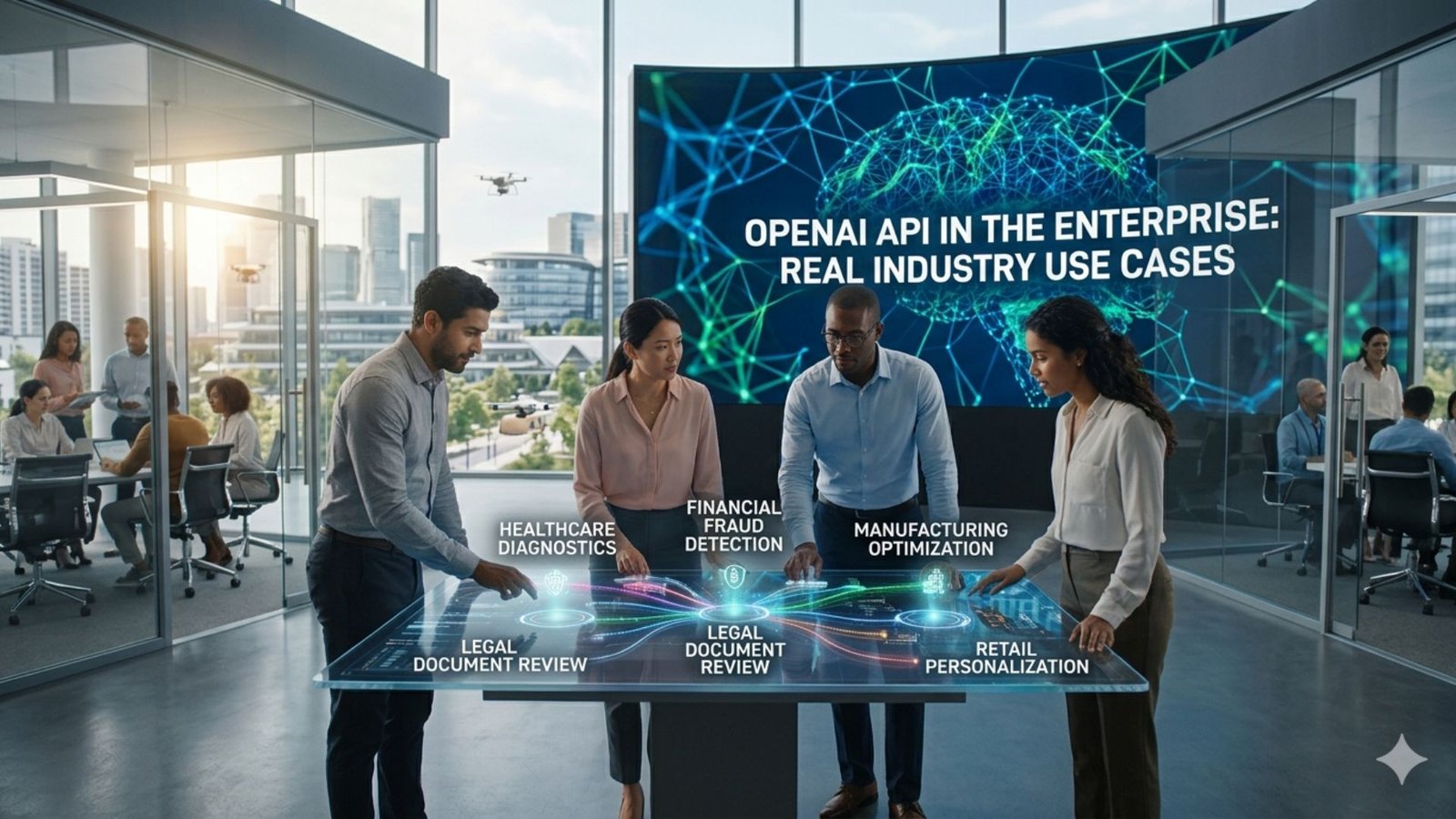
Enterprises aren’t experimenting with OpenAI’s API anymore — they’re running production workloads on it. From hospital systems processing clinical notes to law firms drafting contracts, the shift from pilot programs to full-scale deployment is well underway.
What’s driving this isn’t just hype. It’s measurable output: faster document turnaround, lower support costs, and software built in weeks instead of quarters. OpenAI’s API is currently in use, demonstrating its scalability.
The Shift from Experiment to Infrastructure
A year ago, most enterprise AI projects sat in sandbox environments. Teams would run proofs of concept, show a demo to leadership, and wait for budget approval. That cycle has compressed dramatically.
According to a 2024 McKinsey report, 65% of organizations surveyed said they regularly use generative AI in at least one business function — up from 33% the year before. OpenAI sits at the center of that shift, with its API serving as the backbone for dozens of enterprise platforms and internal tools.
The reason companies keep choosing OpenAI’s models—GPT-4o, GPT-4 Turbo, and the o-series reasoning models—comes down to capability breadth. One API provides access to text, vision, audio, and structured outputs, which means a single integration can handle a range of tasks that would otherwise require multiple vendors.
Healthcare: Clinical Notes, Summarization, and Patient Intake
AI is making significant progress in healthcare, which has some of the highest documentation burdens.
Ambient clinical documentation is the clearest example. Companies like Nuance (owned by Microsoft) and Abridge use OpenAI’s API to transcribe and summarize physician-patient conversations in real time. A doctor speaks naturally during a visit; the system produces a structured clinical note ready for the EHR. At some health systems, the technology has cut documentation time by 50% per encounter.
Patient intake is another active area. Chatbots built on GPT-4 handle pre-visit questionnaires, symptom screening, and appointment scheduling—routing more complex queries to human staff. This isn’t replacing clinical judgment; it’s handling the administrative layer so clinical staff can focus on care.
Insurance pre-authorization is also moving onto the API. Prior authentication requests involve reading clinical documents, matching them against payer criteria, and drafting appeals when denied. That’s a text-heavy, rules-based workflow that language models handle well.
Financial Services: Analysis, Compliance, and Client Communication
Banks and asset managers were initially cautious about generative AI — understandably, given regulatory scrutiny. That caution hasn’t disappeared, but it has given way to structured adoption in specific, lower-risk functions.
JPMorgan Chase reportedly filed a patent for a ChatGPT-like tool to help select investments, built on large language model infrastructure. Morgan Stanley rolled out an OpenAI-powered assistant to its financial advisors, providing them with access to a search tool trained on the firm’s research library — 100,000+ documents condensed into an on-demand query interface.
On the compliance side, teams use OpenAI’s API to scan contracts, flag regulatory language, and generate draft responses to audit queries. A task that once required a paralegal to spend two days pulling precedents now runs in minutes.
Client communication is another use case gaining traction. Wealth management firms use GPT-4 to draft personalized portfolio commentary at scale—a relationship manager can review and send updates to hundreds of clients without writing each one from scratch.
Legal: Contract Review, Research, and Document Drafting
The document-intensive nature of the legal industry makes it a perfect fit for language models.
Firms like Harvey AI — which raised $100 million and counts Allen & Overy among its clients — have built legal-specific tools on top of OpenAI’s models. The core workflow: upload a contract, ask the model to identify risk clauses, summarize obligations, or flag deviations from standard terms. What took a junior associate hours now takes minutes.
Contract drafting is moving in the same direction. Partners describe the deal structure; the model produces a first draft. The lawyer revises. It’s not replacing legal work — it’s shifting where attorney time goes.
Legal research, which traditionally meant hours in Westlaw or LexisNexis, is also changing. Retrieval-augmented generation (RAG) systems built on the API let firms query their case archives and precedent libraries in natural language. Please feel free to ask a question, and you will receive cited answers from the firm’s actual documents.
Retail and E-Commerce: Product Content, Search, and Support
For large retailers, the content problem is real. A company with 500,000 SKUs needs product descriptions, SEO titles, size guides, and FAQs for every item. Manually, that’s not feasible. With OpenAI’s API and a well-structured prompt, it’s a batch job.
Shopify merchants and enterprise retailers alike use GPT-4 to generate product copy at scale, then review and publish. Quality is high enough that many go live with minimal editing.
Search is a bigger opportunity. Traditional keyword search fails when customers type natural queries like “something warm for a winter wedding.” Semantic search is built on embeddings, and the API understands intent, not just terms. Retailers report meaningful improvements in conversion when semantic search replaces keyword-only search.
Customer support automation is arguably the most widespread retail use case. Support bots built on GPT-4 handle returns, order status, and product questions with a fluency that older chatbots couldn’t approach. Escalation to human agents decreases when the AI can effectively answer the question.
Software Development: Code Generation and Internal Tooling
GitHub Copilot—built on OpenAI’s Codex and later GPT-4—has more than 1.8 million paid subscribers and is used by over 50,000 organizations. That number alone signals how deeply AI-assisted coding has entered enterprise development workflows.
But Copilot is just the most visible example. Internal engineering teams at large companies have built their own developer tools on the API: code review assistants, documentation generators, SQL query builders, and incident summarizers that help on-call engineers diagnose production issues faster.
The ROI here is measurable. GitHub’s own research found developers using Copilot complete tasks up to 55% faster than those who don’t. For enterprises paying developer salaries in the $150,000–$250,000 range, even a 20% productivity gain has a clear dollar value.
The Challenges Enterprises Are Still Working Through
Adoption is real, but it’s not frictionless.
Data privacy is the most common concern. Enterprises in regulated industries—healthcare, finance, and legal— need guarantees about where their data goes. OpenAI’s enterprise tier offers zero data retention by default and contract-backed privacy terms, which have helped, but security reviews still slow rollouts.
Hallucination risk hasn’t gone away. In high-stakes contexts, a confident wrong answer is worse than no answer. Most enterprise deployments address this issue through retrieval-augmented generation (pulling answers from verified documents rather than model memory alone), human review workflows, and output guardrails. But it requires engineering effort.
Integration complexity is underestimated. Connecting an API to existing systems—legacy ERPs, on-premise databases, custom CRMs—takes real work. Companies that treat OpenAI’s API as a drop-in solution typically hit friction quickly.
Cost management is a growing concern as usage scales. Token costs add up fast when you’re running thousands of documents through GPT-4. Many teams are now running model-routing strategies—using cheaper, smaller models for simpler tasks and reserving GPT-4 for high-complexity work.
What the Next 18 Months Look Like
The trend is toward deeper integration, not wider experimentation. Enterprises that started with one use case are expanding to three or four. Teams that built proofs-of-concept are rebuilding them as production systems with proper logging, evals, and fallback handling.
OpenAI’s O3 and O3-mini reasoning models are creating new opportunities in scientific research, complicated financial modeling, and detailed legal analysis—areas where GPT-4 might make mistakes that a slower, more careful reasoning approach can avoid.
The next frontier is agentic workflows. Rather than single-turn queries, enterprises are building multi-step agents that can research, draft, review, and route work autonomously. Early deployments exist in HR (onboarding workflows), finance (invoice processing pipelines), and IT (ticket triage and resolution).
The companies getting the most out of OpenAI’s API right now aren’t just plugging in a model. They’re redesigning workflows around what the model can actually do—and that takes time, internal expertise, and a clear-eyed view of where AI helps and where it doesn’t.
Conclusion
Enterprise deployment of OpenAI’s API has moved well past the exploration phase. Healthcare systems are reducing documentation hours. Banks are giving advisors better research tools. Law firms are processing contracts faster. Retailers are generating content at scale.
Engineering and governance, rather than avoidance, are addressing the practical challenges of data privacy, hallucinations, integration work, and cost. For most large organizations, the question is no longer whether to deploy AI. It’s how to do it without creating new operational risks.
The industries moving fastest are the ones willing to redesign workflows, not just bolt AI onto existing ones.
Also see:
Revolutionizing Healthcare: The Impact of Artificial Intelligence
The Rise of Cloud-Native Applications: Harnessing the Potential of Modern Architectures