
Apple Launches M5 Chip Family in New MacBook Air and Pro
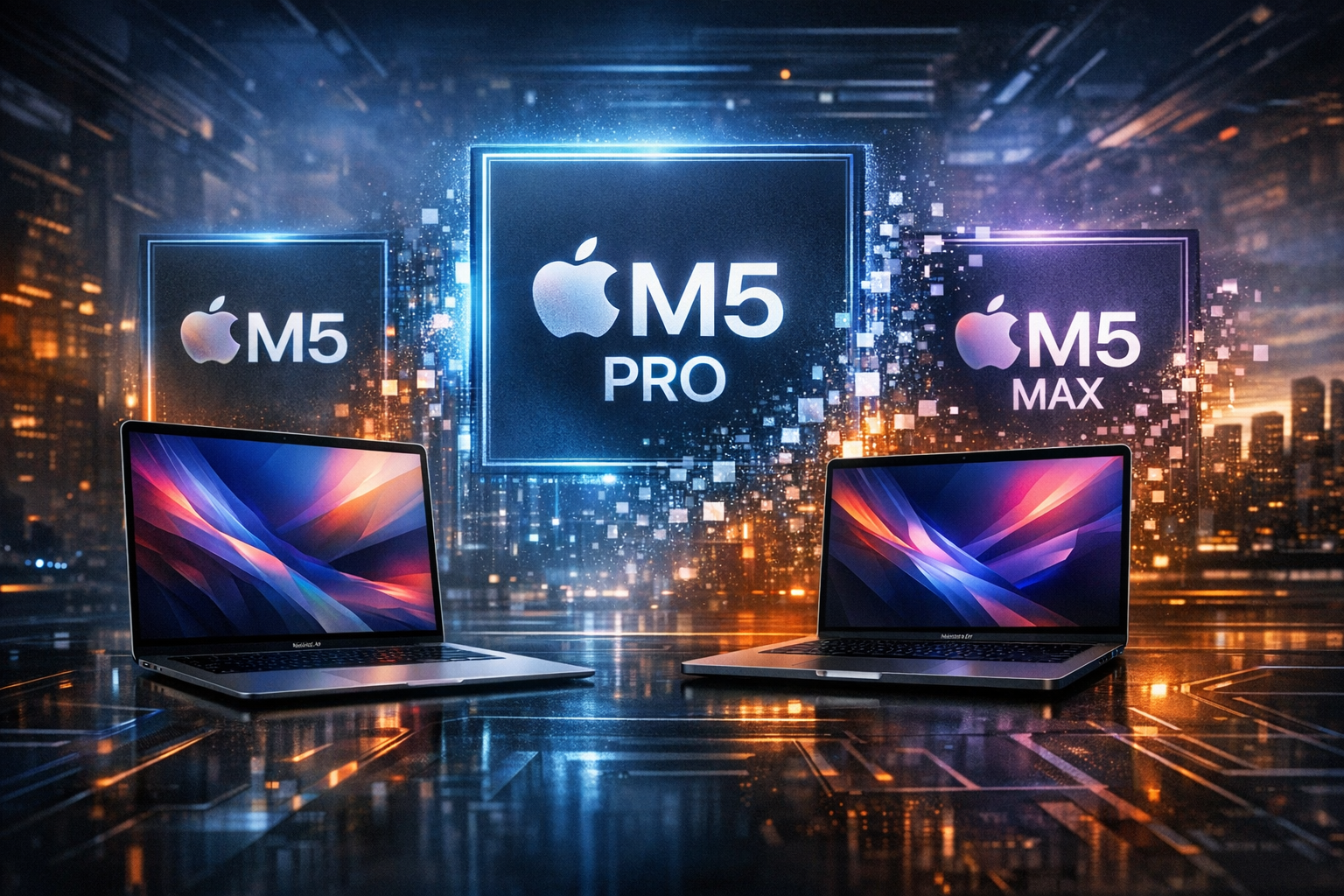
Apple has officially launched a new generation of laptops powered by its latest silicon lineup: the M5, M5 Pro, and M5 Max chips. The refreshed models include the new MacBook Air and MacBook Pro, bringing major improvements in performance, AI acceleration, and graphics capability.
While base models keep the same price, Apple has raised the cost of high-end M5 Max configurations by about $400. This signals a shift toward more powerful professional hardware tiers.
The launch continues Apple’s strategy of advancing its in-house chip architecture, delivering faster performance and better energy efficiency while strengthening its position in the premium consumer laptop market.
Background & Context
Apple began transitioning away from Intel processors in 2020 with the launch of the Apple M1 chip. The shift marked a major transformation in consumer computing, as Apple started designing processors optimized for macOS and its hardware ecosystem.
Since then, Apple has steadily improved its silicon lineup:
- Apple’s M2 chip introduced better GPU performance and memory bandwidth.
- Apple M3 chip delivered hardware ray tracing and improved graphics efficiency.
- Apple’s M4 chip strengthened AI processing through enhanced neural engines.
Now the M5 family represents the next stage of Apple’s silicon evolution, focusing on three major areas:
- Advanced CPU architecture
- Expanded GPU capabilities
- More powerful AI processing through neural engines
These improvements are important as laptops increasingly handle workloads involving machine learning, generative AI, video production, and 3D graphics.
The M5 Chip Family Explained
Apple’s new silicon lineup includes three tiers designed for different user groups.
M5 – The Consumer Performance Chip
The base Apple M5 chip powers the latest MacBook Air and entry-level MacBook Pro models.
It is designed to balance performance, battery life, and affordability, making it ideal for everyday computing tasks.
Key architectural components include:
CPU (Central Processing Unit)
The M5 CPU is expected to feature a hybrid architecture combining:
- Performance cores for demanding tasks
- Efficiency cores for background processes
This approach allows the chip to maintain performance while preserving battery life.
Compared with the previous generation, the M5 CPU delivers improvements in:
- Single-core processing speed
- Multitasking responsiveness
- System efficiency
These upgrades translate into smoother everyday performance for tasks like:
- Web browsing
- Document editing
- Video conferencing
- Light creative work
GPU (Graphics Processing Unit)
The integrated GPU inside the M5 is optimized for graphics-heavy tasks such as:
- photo editing
- video playback
- casual gaming
Apple has improved the GPU architecture to support higher frame rates and faster rendering speeds compared with the previous generation.
Neural Engine (AI Processor)
One important component is the Neural Engine, which accelerates machine learning tasks.
This chip-level AI hardware enables faster execution of:
- image recognition
- voice processing
- AI-powered editing tools
- generative AI workflows
As AI features become more integrated into operating systems and apps, the Neural Engine plays a vital role in overall laptop performance.
M5 Pro: Built for Professional Workloads
The next tier, the Apple M5 Pro chip, powers higher-end MacBook Pro models.
This chip is designed for developers, engineers, and creative professionals who need more computing power.
Compared with the base M5 chip, the M5 Pro offers:
More CPU Cores
Additional performance cores enable faster handling of demanding tasks such as:
- software development
- data analysis
- professional video editing
These extra cores improve multithreaded performance, allowing applications to complete complex workloads faster.
Expanded GPU Power
The GPU inside the M5 Pro is also upgraded with additional graphics cores.
This improves performance in areas like:
- 3D rendering
- animation workflows
- high-resolution video production
- professional design software
For users working with creative tools such as video editing platforms and 3D modeling software, the GPU improvements can reduce render times.
Higher Memory Bandwidth
Another major upgrade in the M5 Pro architecture is faster unified memory bandwidth.
Apple’s unified memory system allows the CPU, GPU, and neural engine to access the same memory pool, reducing latency and improving performance across the system.
This design provides advantages for tasks involving large datasets, such as:
- editing 8K video
- compiling large codebases
- running AI models locally
M5 Max: Apple’s Most Powerful Laptop Chip

At the top of the lineup is the Apple M5 Max chip, which powers the highest-end MacBook Pro configurations.
The M5 Max is engineered for demanding professional workloads and delivers major upgrades in three areas.
Massive GPU Performance
The M5 Max dramatically expands the GPU architecture, enabling:
- advanced 3D graphics rendering
- real-time visual effects processing
- large-scale machine learning tasks
These capabilities are especially valuable for industries such as:
- film production
- game development
- scientific simulation
- AI model experimentation
Higher Unified Memory Capacity
The chip supports larger unified memory configurations compared with lower-tier chips.
More memory allows professionals to work with:
- complex 3D scenes
- high-resolution video timelines
- large AI datasets
without performance slowdowns.
Extreme Multicore CPU Power
The M5 Max also includes a much larger CPU configuration optimized for parallel workloads.
This makes it particularly effective for:
- compiling massive software projects
- running virtualization environments
- complex data modeling
However, these upgrades come with a cost. Apple has raised the prices of M5 Max MacBook Pro models by about $400 to reflect the increased performance.
Hardware Improvements Beyond the Chip
While the chips are the headline feature, Apple’s latest laptops include additional improvements.
Battery Efficiency
Apple silicon continues to lead the industry in performance-per-watt efficiency.
The new M5 chips allow the MacBook Air and MacBook Pro to maintain long battery life while running demanding applications.
AI Integration
The enhanced neural engine improves performance for AI-powered features across:
- macOS system tools
- photo and video editing apps
- generative AI software
Local AI processing reduces reliance on cloud computing for certain tasks.
Thermal Design
The MacBook Pro models feature advanced cooling systems that enable the M5 Pro and M5 Max chips to maintain high performance under heavy workloads.
The MacBook Air maintains its fanless design, benefiting from the M5 chip’s efficiency.
Comparison With Previous Generation Chips
The M5 generation continues Apple’s pattern of incremental yet meaningful improvements.
| CPU Architecture | High performance | Improved efficiency and faster cores |
| GPU | Advanced graphics | More powerful rendering and gaming capability |
| Neural Engine | AI acceleration | Faster AI inference and processing |
| Memory Bandwidth | High-speed | Further expanded bandwidth |
| Professional Workloads | Strong performance | Faster rendering and compute tasks |
While the changes may appear incremental, the cumulative improvements make the new laptops more capable for modern workflows.
Industry Implications
The M5 launch reinforces Apple’s leadership in custom silicon for consumer laptops.
Competitors like Intel and AMD continue developing powerful laptop processors, but Apple’s vertical integration offers several advantages:
- tighter hardware and software optimization
- better energy efficiency
- faster AI processing
- unified memory architecture
As a result, Apple laptops often deliver strong real-world performance while using less power.
The M5 chips also reflect a broader trend in computing: processors are increasingly optimized for AI workloads rather than just traditional CPU tasks.
Future Outlook
Looking ahead, Apple’s silicon roadmap suggests continued focus on:
- AI acceleration
- graphics performance
- energy efficiency
- unified memory architecture
As software relies more on machine learning and AI tools, these capabilities will become essential components of modern laptops.
The M5 generation positions Apple to support these workloads while maintaining its reputation for efficient, high-performance consumer hardware.
Overview: MacBook Pro M5 Pro & M5 Max

Apple’s latest powerhouses arrive with a focus on massive throughput and industry-leading efficiency. Whether you’re eyeing the 14-inch portability or the 16-inch screen real estate, the internal upgrades are substantial.
Key Highlights
- Launch Timeline: Pre-orders begin March 4, with full retail availability on March 11.
- Performance Leap: The M5 Pro and M5 Max chips deliver a 30% CPU performance increase over the previous generation.
- High-Speed I/O: Now featuring three Thunderbolt 5 ports for elite data transfer and peripheral support.
- Enhanced Connectivity: Introduction of a custom wireless chip supporting Wi-Fi 7 and Bluetooth 6.
- All-Day Endurance: Apple claims a class-leading 24-hour battery life.
- Storage Floor Raised: Starting capacities have doubled to 1TB for the M5 Pro and 2TB for the M5 Max, featuring lightning-fast 14.5GB/s speeds.
Technical Specifications Comparison
| Feature | 14-inch MacBook Pro (M5 Pro) | 16-inch MacBook Pro (M5 Max) |
| Starting Price | $2,199 | $3,899 |
| Display | 14.2″ Liquid Retina XDR (120Hz) | 16.2″ Liquid Retina XDR (120Hz) |
| Chipset | M5 Pro (15-core CPU, 16-core GPU) | M5 Max (18-core CPU, 32-core GPU) |
| Unified Memory | 24GB (Base) | 36GB (Base) |
| Storage | 1TB SSD | 2TB SSD |
| Connectivity | Wi-Fi 7 / BT 6 / TB 5 | Wi-Fi 7 / BT 6 / TB 5 |
| Camera | 12MP Center Stage | 12MP Center Stage |
| Weight | 3.5 lbs | 4.7 lbs |
| Colors | Silver, Space Black | Silver, Space Black |
Conclusion
The launch of the M5-powered MacBook Air and MacBook Pro marks another major step in Apple’s silicon evolution. With the M5, M5 Pro, and M5 Max chips, Apple is delivering improvements in CPU power, graphics processing, and AI acceleration across its laptop lineup.
While the $400 price increase for M5 Max models may raise eyebrows, the performance upgrades target professionals who rely on extreme computing power for demanding workloads.
For everyday users, creators, and developers alike, the M5 generation represents a powerful new chapter in Apple’s growing dominance in consumer laptop hardware.
Also see:
2026 Flagship Face-Off: Samsung S26 Ultra vs Xiaomi 17 Ultra