RAMmageddon: The Impending RAM Shortage and AI Implications
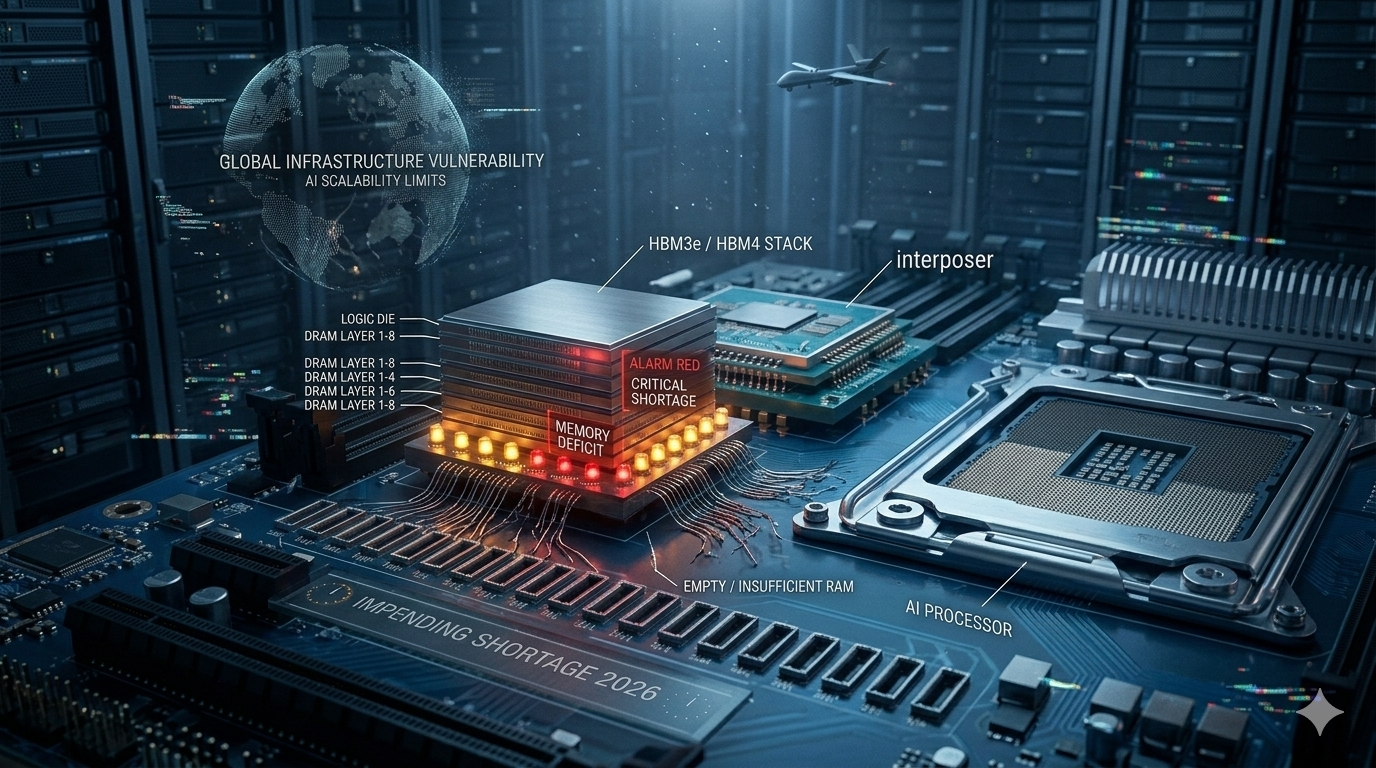
A looming RAM shortage, dubbed “RAMmageddon,” is now poised to disrupt global technology supply chains as explosive AI demand pushes chip supplies to a critical breaking point.
Memory manufacturers now prioritize chips for AI infrastructure and data centers, diverting resources from consumer devices and potentially leading to higher prices and fewer choices as shipments decline.
Industry leaders, including Samsung Electronics, SK Hynix, and Micron Technology, are dedicating significant resources to advanced memory technologies to support AI workloads. However, the rapid expansion of AI computing—driven by companies like NVIDIA and OpenAI—is absorbing massive volumes of memory chips that would traditionally supply consumer devices.
This swiftly deteriorating supply-demand imbalance is igniting widespread alarm over an imminent global AI memory crisis, threatening to devastate everything from everyday smartphone affordability to the backbone of enterprise computing infrastructure.
In this article, we will explore the causes of the RAM shortage in 2026, its consequences for the technology market, and how businesses and consumers may be affected.
Why AI Is Driving the RAM Shortage
Artificial intelligence now drives semiconductor demand. Modern AI models require significant computing power, mostly driven by high-speed memory.
Large-scale AI systems—such as generative AI models and advanced machine learning platforms—consume massive quantities of high-bandwidth memory (HBM) and DRAM.
NVIDIA GPU-powered AI training clusters require high-performance memory to process large datasets. Each accelerator uses multiple advanced chips, creating much higher demand than standard workloads.
For example:
- A typical AI training server may require 8–12 GPUs
- Each GPU can require tens of gigabytes of high-bandwidth memory.
- Data centers deploy thousands of these servers.
This rapid AI growth is quickly consuming global memory supplies.
Consequently, chipmakers are focusing on AI-grade memory rather than standard DRAM for personal devices.
Understanding the Global RAM Shortage 2026
The 2026 RAM shortage results from several converging commercial trends.
1. AI Data Centers Consuming Massive Memory
Hyperscale data centers operated by companies like Amazon Web Services, Google Cloud, and Microsoft Azure are expanding rapidly to support AI applications.
These facilities require enormous volumes of memory chips to support GPU units, inference systems, and large-scale databases.
AI infrastructure frequently demands dedicated memory such as HBM3 or HBM3E, which is far more complex to manufacture than traditional DRAM.
2. Limited Semiconductor Manufacturing Capacity
Despite major investments, manufacturing remains limited.
Building a new memory fabrication plant can cost more than $20 billion and take several years to become operational.
Major chipmakers, including TSMC and Intel, are expanding manufacturing capabilities, but these facilities will not fully alleviate supply constraints in the short term.
3. Memory Manufacturers Prioritizing High-Profit Chips
AI-focused memory chips command significantly higher margins than traditional DRAM.
Memory producers prioritize high-value AI products over consumer memory.
This shift tightens DRAM supply for PC and smartphone manufacturers.
How the AI Memory Crisis Could Impact PC Prices
A sharp 2026 RAM shortage could cause PC prices to spike. Because laptops and desktops depend on DRAM, manufacturers must raise prices or absorb higher costs.
Leading PC makers such as Dell Technologies, HP Inc., and Lenovo could face higher component costs if DRAM supply becomes constrained.
Higher RAM prices may lead to:
- More expensive laptops and desktops
- Reduced availability of high-memory configurations
- Slower refresh cycles for consumer devices
Businesses purchasing enterprise workstations and servers may incur even higher costs due to their higher memory requirements.
Smartphone Prices Could Also Rise
The 2026 RAM shortage could also disrupt the smartphone market.
Flagship smartphones now ship with 8GB to 16GB of RAM, and some gaming phones exceed 24GB. This increase in memory capacity shows rising demand for multitasking, AI features, and high-efficiency applications.
Leading smartphone manufacturers such as Apple, Samsung Electronics, and Xiaomi rely heavily on global DRAM supply chains.
If memory prices rise significantly, manufacturers may respond by:
- Increasing smartphone retail prices
- Reducing RAM in midrange devices
- Delaying new product launches
Consumers may see higher prices, fewer RAM options, and limited choices in 2026.
Potential Drop in Global Device Shipments
Beyond rising prices, analysts are urgently warning: the AI memory crisis could cause a sudden and severe collapse in global shipments of PCs and smartphones. If manufacturers cannot secure enough memory, drastic production cutbacks could follow imminently.
This scenario could lead to:
- Lower global PC shipments
- Slower smartphone market growth
- Extended device upgrade cycles
Consumers may face higher device prices, fewer options, and longer waits for upgrades, making new technology less accessible.
Why High-Bandwidth Memory Is the Real Bottleneck
A major factor behind the RAM shortage in 2026 is the growing demand for high-bandwidth memory (HBM).
HBM is a specialized type of memory that uses advanced packaging technology to stack vertically. It provides significantly higher data throughput than traditional DRAM.
AI accelerators, particularly GPUs used for deep learning, rely heavily on HBM to process big datasets quickly.
However, HBM production is extremely complex and entails advanced manufacturing processes such as:
- 3D chip stacking
- Through-silicon vias
- High-density packaging
Few companies can mass-produce HBM, so the supply is very limited.
This acute shortage is now one of the gravest and most immediate drivers of the AI memory crisis, demanding swift and decisive global action. The Semiconductor Industry Is Responding
To address the RAM shortage in 2026, semiconductor companies are rapidly expanding production.
For example:
- Samsung Electronics is investing billions of dollars into next-generation memory fabs.
- SK Hynix is ramping up HBM production for AI accelerators.
- Micron Technology is developing advanced DRAM architectures to increase capacity and performance.
Governments are also stepping in.
Programs such as the CHIPS and Science Act in the United States aim to strengthen domestic semiconductor manufacturing and lessen reliance on overseas supply chains.
However, these interventions will not bring timely relief—the world faces a prolonged and severe period of supply pain before chip production can catch up, with urgent consequences for businesses and consumers alike.
What Businesses Should Do to Prepare: Organizations that rely on hardware infrastructure should begin planning for potential memory shortages.
Multiple strategies can help lessen the impact.
Optimize Infrastructure
Companies should evaluate whether their systems are using memory efficiently and consider optimizing workloads to reduce RAM requirements.
Secure Long-Term Supply Agreements
Enterprises purchasing large volumes of servers may benefit from negotiating long-term supply contracts with hardware vendors.
Adopt Cloud-Based Infrastructure
Cloud providers frequently have stronger supply chain relationships with chip manufacturers, enabling them to secure components more effectively.
The Future of Memory Technology
The RAM shortage in 2026 may accelerate innovation in memory technologies.
Researchers are already exploring alternatives such as:
- Compute-in-memory architectures
- Next-generation DRAM
- Non-volatile memory solutions
- Optical memory technologies
Though still in development, these alternatives could eventually reduce dependence on traditional DRAM and HBM.
The current memory crisis may spark the next phase of semiconductor innovation.
Conclusion
The looming RAM shortage in 2026 underscores the escalating, potentially catastrophic impact of artificial intelligence on the global technology supply chain. As AI infrastructure expands at unprecedented speed, demand for high-efficiency memory chips is spiraling out of control. A sudden spike in demand could trigger “RAMmageddon,” in which memory supply catastrophically fails to keep up with industry demand.
Consumers now face soaring PC and smartphone prices, while manufacturers are immediately threatened by crippling production constraints and plummeting device shipments.
At the same time, this crisis highlights the vital need for resilient, strategic semiconductor manufacturing and supply chains.
As AI rapidly transforms the technology landscape, memory chips are fast becoming among the most contested and valuable resources in the digital economy. Companies and countries that secure reliable access to these critical components will play a decisive role in determining the future of computing.